
Previous Residents at a Staunton Address
The earliest useful source depends on the time period. Start with today’s parcel because it supplies the PID and legal description needed to connect an address with deeds. Then choose the source that matches the missing interval. Deed books document recorded property transfers. Directories and newspapers can add a dated person, business, or address clue. Sanborn sheets describe the built place. The table preserves the coverage limits, including materials that must be requested or confirmed in person.
| Source | Years It Covers | Where Held | What It Shows |
|---|---|---|---|
| Staunton deed books 1 to 4 | 1802–1867 | Library of Virginia microfilm and clerk | Instruments, parties, legal descriptions, and book references |
| Grantor and grantee indexes | 1802–1951 | Library of Virginia microfilm and clerk indexes | Party-name route into a deed book, not a household roll |
| Staunton city directories | Various 1895–1934 | ACHS-linked digitized collection and local research holdings | Address, household or business clues, with gaps in the working run |
| Directories reported by HABS | Most years 1940–1983 | Clerk’s Office basement at the HABS survey; current custody unverified | Post-1934 address tracing if the volumes can be located |
| Sanborn maps | 1891–1929, with pasteovers through 1966 | Historic Staunton Foundation holdings | Building footprint, use, material, and street context |
| Newspaper microfilm | Late 1700s–present, title-specific | Staunton Public Library reference area | Sale notices, obituaries, business moves, building events, and notices |
A current assessor record has no verified historic-span promise. Use it for the present parcel, then use the clerk, Library of Virginia, library, archives, and map collections for the earlier trail.
Start a Staunton Previous Residents Trail
Before looking for names, record the current PID, situs, legal description, subdivision or lot and block, map or tracing reference, and date of the parcel source. The 2025 DSD sample shows why the fields need to remain separate. It has a physical situs, an owner or co-owner, a legal description, a subdivision, a mailing field, and map or tracing information. A mailing destination is not a historical-residence finding. The legal description is usually the stronger bridge when a number changes or a parcel split occurs.
Staunton is an independent city beside a separate Augusta County jurisdiction. Confirm the address before asking either clerk for records. A historic mention of Augusta County may be correct for an earlier trail, but it does not make a present city parcel a county record. Keep the city or county label exactly as the source provides it.
Trace a Staunton Deed Chain Backward
A chain of title moves from the present parcel to earlier conveyances. Search the current owner as a grantee, find the purchase instrument, then use the prior party as a grantee in an earlier window. Compare the legal description at every handoff. Recording date, execution date, and tax-record date are different dates. An estate, trustee, executor, corporation, correction deed, or parcel split can interrupt an apparent one-name-to-one-name sequence.
- Open the current assessor or GIS record and save the PID, situs, legal description, and owner exactly as displayed.
- Use the owner as grantee in the land index. Record the grantor, instrument type, date, book and page or document number, and any visible legal description.
- Search the prior grantor as grantee in an earlier date range. Allow for initials, middle names, estate names, trustees, and corporate suffixes.
- Match the lot, block, landmark, or other legal wording before deciding the older deed describes the same parcel.
- Repeat until the needed era, then use the Library of Virginia reel or clerk route when the index or image is not available online.
- Grantor
- The party transferring an interest in a recorded instrument.
- Grantee
- The party receiving an interest in that instrument. Searching a prior party as grantee can reveal the earlier purchase.
- Chain of title
- A sequence of recorded transfers connected by the same legal description, not merely by a similar street address.
- Legal description
- The lot, block, tract, landmark, or other land description used in a deed to identify the property.
- Enumeration district
- The census area used to organize a census schedule. It helps locate an address after the correct time and jurisdiction are established.
The Virginia Circuit Court Secure Remote Access land-record system is the online route for participating clerk offices, but access depends on locality and account conditions. The captured SRA page shows that access step before a search result is assumed.
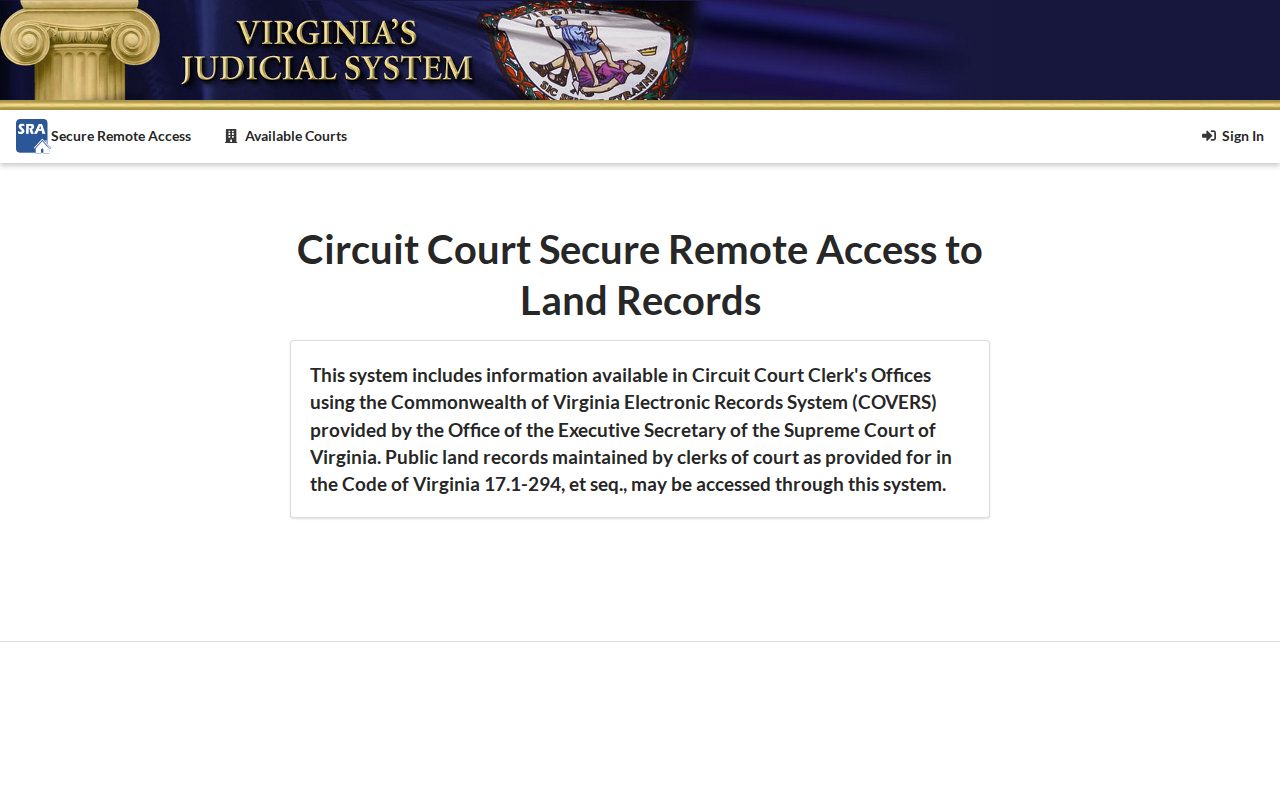
When SRA does not provide the needed image or index view, the clerk counter and Library of Virginia microfilm are documented alternatives, not dead ends.
Staunton Deed Books Reach Earlier Years
For the early portion of a previous-residents search, use the Library of Virginia’s city microfilm catalog. It identifies Staunton deed books 1 through 4 as 1802–1817, 1817–1838, 1839–1854, and 1854–1867. Its grantor and grantee indexes run 1802–1951 in letter groups. The catalog also identifies city wills, marriage records, council minutes, court series, and other material that may resolve a name or date after the land trail has been established.
Ask for the relevant reel after documenting the index line, book and page, and legal-description page needed. Staunton’s clerk and Library of Virginia catalog present slightly different summary dates for some city series, so preserve each source’s catalog wording rather than forcing them into a single date claim. A missing name or image can mean a different letter group, an unindexed instrument, an estate name, or an unexamined reel.
The Library of Virginia Staunton microfilm catalog lists the city record series and reel route.
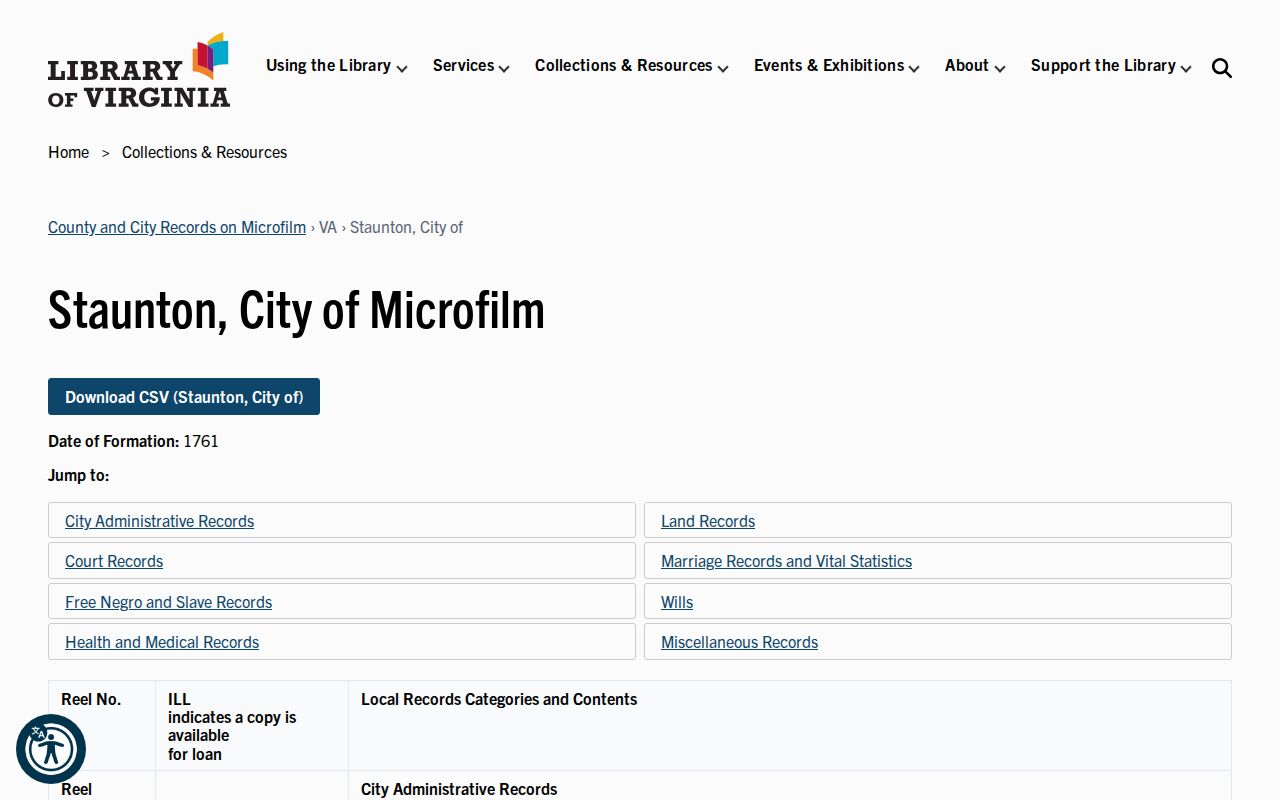
The catalog is a finding aid for a historical series. It identifies where to look, while the reel or clerk copy supplies the actual document evidence.
Staunton Directories Fill Record Gaps
Deeds show ownership transfers, but the interval between transfers often needs a different source. The ACHS-linked digitized collection is labelled “Staunton City Directories | Various 1895–1934.” The working local run includes 1895, 1896–97, 1899, 1904–05, 1910–11, 1916–17, 1922–23, 1927, 1929, 1931, and 1934. It is a working run, not proof that no other year exists. HABS separately reports directories for most years from 1940 to 1983, with publisher unknown and current physical custody unverified.
Transcribe the directory year, page, street and number, person or business name, role markers, abbreviations, adjacent entries, and source image URL. Do not convert an entry into a present-day identity. The collection detail and its access limits are described on the Staunton Directory Book page.
The digitized Staunton directory search is the source route for available scans.

A scan that is absent or difficult to access is a collection gap to document. It is not evidence that an address had no historical occupant.
Pair Staunton Directories with Census
Household evidence is strongest when its time period is stated. Read a directory entry in the year printed, then look for a census schedule or newspaper notice that covers the same general period. Staunton Public Library’s reference material includes Augusta and area census microfilm for 1810–1930, as well as local newspaper microfilm. Match the source’s jurisdiction first, because older county material and later independent-city material can be filed differently.
Use a short comparison flow: directory year and page, then census year and enumeration district, then newspaper title, date, and page if a notice supplies a move, death, sale, or business clue. Each layer should retain its own label. A census schedule may describe a household, while a directory can show a street address and a deed can establish a transfer. None replaces the others.
Staunton Sanborn Sheets Date Buildings
Sanborn fire-insurance maps add a building layer to the previous-residents trail. The Staunton series identified through Historic Staunton Foundation includes 1891, 1894, 1899, 1904, 1909, 1914, 1921, and 1929, with pasteovers through 1966. A sheet can help compare footprint, use, materials, street context, and nearby structures at a documented date. It does not identify every person connected with the property.
Use the sheet date alongside the deed interval and a directory year. The official local project research on 240 N Madison used a 1949 Sanborn reference and a 1950 directory to study building use. That is a sound model for triangulating a building history without claiming an uninspected directory row proves a person’s connection.
Staunton Names Change Across Maps
Historic address wording needs its own research note. The Library of Congress HABS report on Putnam Organ Works traces an 1893 conveyance from Ashner Ayers, Trustee, to A.M. Valz and describes a frontage on West Main Street near S.D. Timberlake’s building. The report bridges the historic Main and Water reference to present Beverley and Central Avenue. That geographic bridge is useful for finding the next source, not a substitute for matching the legal description.
No official citywide street-renumbering year or complete conversion table was verified. Preserve the old name, number, landmark, and lot or block wording. Then compare historic city plans, directories, Sanborn maps, and the original instrument before translating it to a current parcel.
Staunton Reference Help Connects Clues
Some gaps are solved by a person who knows the local collections. Staunton Public Library’s Genealogy Collection is in the first-floor reference area and includes city and business directories, maps, local-history files, telephone directories, newspapers, and research tools. A request is more useful when it includes a name variant, former street name, approximate year, occupation, organization, or legal description. The library’s reference number is 540-332-3902.
Other documented routes include ACHS, Historic Staunton Foundation, and the Mary Baldwin Grafton Library. ACHS has property, family, church, cemetery, photograph, tax, road-order, and local-history material, subject to appointment or reproduction limits. Historic Staunton Foundation has historic-district property files and Sanborn material. The strongest request asks for a specific source and interval, not every record about a person.
Watch New Staunton Recordings
For a current property owner, the city joined Virginia’s free VADeed Alert service in March 2026. The service sends notices for recordings monitored by name or PID, and the city directs users to find the PID in the VGSI assessor database. An alert can provide a prompt to inspect a new official recording. It does not replace the clerk’s document, prove an older transfer, or complete a historical chain.
Use the alert only for lawful monitoring of a property interest and retain the notice date with the deed-research notes. The source record remains the recorded instrument obtained through the appropriate clerk or SRA route.
Limits on Staunton Previous Residents Research
Public historic material can support house history, family history, estate questions, and local research. It cannot prove every person who spent time at an address, and a public index does not open protected underlying records. Adoption files, protected victim information, sealed records, restricted voter information, and Virginia Address Confidentiality Program addresses remain subject to separate limits. Preserve uncertainty in the research log when a source does not establish a connection.
Lawful use. Use past-resident research for history and personal records work. Do not use an address trail to stalk, harass, intimidate, or harm anyone.